


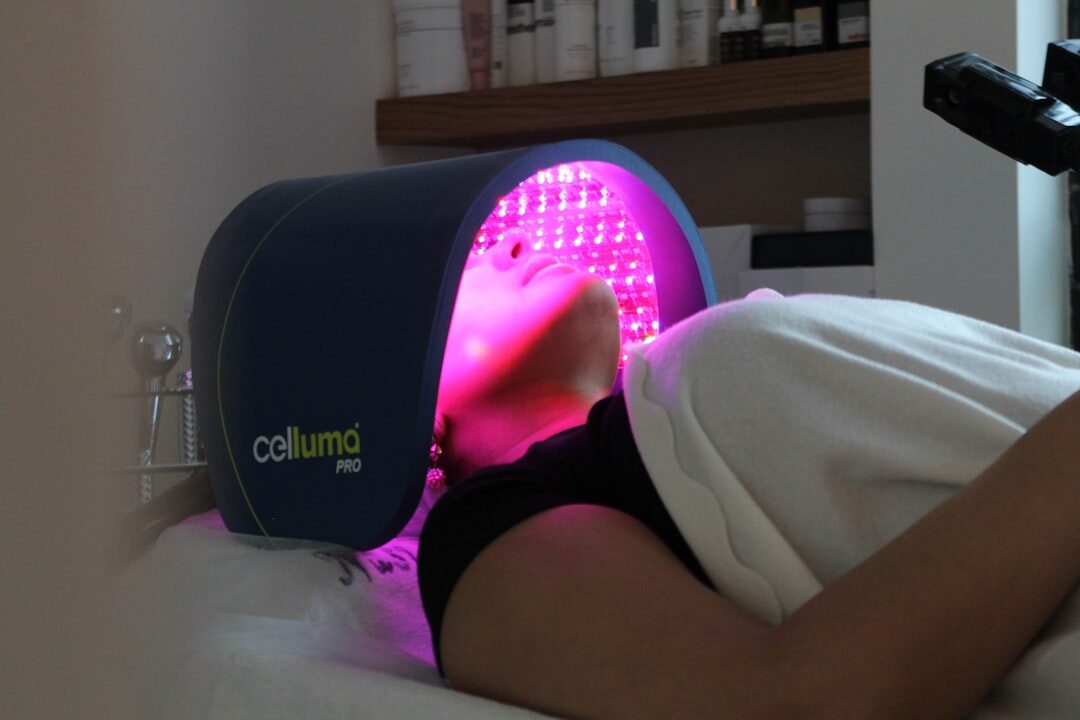
What Is RF Microneedling for Stretch Marks, Exactly?
RF microneedling for stretch marks is a treatment that pairs traditional needling with radiofrequency (RF) energy, and it gets confused with two very different services more often than almost any other term we hear at Lumière Beauty & Spa. Clients researching stretch-mark options online frequently ask whether our Microneedling + Salmon DNA Serum Infusion includes RF, or whether our RF facial uses needles. It doesn’t do either, and that mix-up is exactly why this guide exists: to explain what RF microneedling actually is as its own category, what the research says about it for stretch marks specifically, and how it relates to the two separate treatments we do offer in Murray.
Key Takeaways
- RF microneedling for stretch marks uses insulated needles that deliver radiofrequency heat into the dermis in addition to the mechanical puncture — it is a distinct modality, not a stronger version of either service alone.
- A 2024 meta-analysis found statistically significant improvement specifically in the microneedle-RF treatment subgroup for stretch marks (striae distensae).
- Newer, red stretch marks (striae rubra) respond noticeably better than older, white stretch marks (striae alba) in the published studies.
- Lumière offers Microneedling + Salmon DNA Serum Infusion (needling only, no RF) and a Non-Surgical Face/Neck RF Facial (RF only, no needles) as two separate services — we do not currently combine RF energy directly into our microneedling protocol.
How RF Microneedling Differs From Standard Microneedling
Standard microneedling is purely mechanical. Fine needles create controlled micro-injuries in the skin, triggering the classic wound-healing cascade — inflammation, then proliferation, then remodeling — which activates fibroblasts and prompts new collagen and elastin synthesis. This is the mechanism behind treatments like our Microneedling + Salmon DNA Serum Infusion, where the needling does the structural work and a PDRN/salmon-DNA serum supports the skin during healing.
RF microneedling adds a second, separate input. Cleveland Clinic notes that its needles are specially insulated and deliver high-intensity radiofrequency energy directly into the targeted tissue beneath the skin, producing a uniform warming effect that helps stimulate new collagen fibers. In practice, that means mechanical injury plus controlled thermal coagulation in the dermis at the same time, rather than mechanical injury alone. One 2026 stretch-mark study even found upregulation of key extracellular-matrix genes — COL4A1, COL6A1, and elastin (ELN) — after RF-based treatment, a more robust remodeling signal than mechanical injury alone tends to produce.
Does RF Microneedling for Stretch Marks Actually Work?
Stretch marks, or striae distensae, are essentially dermal scars with disrupted collagen and elastic fiber architecture. That’s why dermal-remodeling treatments — microneedling, RF microneedling, and fractional lasers — are studied far more heavily for stretch marks than surface-only approaches. A 2024 systematic review and meta-analysis found significant clinical improvement specifically in the microneedle-radiofrequency treatment subgroup (SMD: 0.57, 95% CI 0.20–0.94, P=0.003), marking some of the first solid meta-analytic evidence for this exact subtype. A separate comparative study on RF microneedling for stretch marks found that both striae rubra (newer, red marks) and striae alba (older, white marks) improved progressively across visits, with striae rubra showing the stronger response — roughly 44–49% improvement versus 37–42% for striae alba by the three-to-six-month mark. A prospective fractional RF study following patients for 16 weeks across four treatments reported average improvements of 19.1% in striae volume, 14.3% in redness, and 11.2% in pigmentation.
It’s worth setting expectations honestly here: the realistic goal across nearly all of this literature is partial improvement in color, texture, and thickness — not complete removal of stretch marks. Anyone comparing options should read “improvement” claims with that in mind, regardless of which modality a provider is using.

RF Microneedling vs. a Standalone RF Skin-Tightening Facial
This is the second common mix-up. A standalone RF skin-tightening facial — like Lumière’s Non-Surgical Face/Neck RF Facial — delivers radiofrequency energy over the surface of the skin through an external handpiece, with no needle penetration at all. Cleveland Clinic describes this approach as heating deeper skin layers to stimulate collagen and elastin and firm sagging skin, and because there’s no channel carrying energy directly into the dermis, it tends to be less focal than needle-delivered RF. It also means shorter downtime: redness and swelling from a surface RF facial typically resolve within about 24 hours, versus several days that’s more typical after a needle-based RF procedure.
For stretch marks specifically, the published evidence leans toward needle-delivered approaches — standard microneedling, RF microneedling, and fractional lasers — rather than surface-only RF, since energy needs to reach the dermis where the disrupted collagen sits. A standalone RF facial suits someone whose main goal is general firmness and laxity with minimal downtime; it isn’t typically the first-choice modality when stretch marks are the primary concern.
What to Expect With RF Microneedling for Stretch Marks: Sessions, Timeline, and Results
Published protocols for RF microneedling for stretch marks commonly use around three to four sessions spaced roughly a month apart, in line with Cleveland Clinic’s general guidance of three to six sessions for microneedling-based stretch-mark treatment. Some early improvement is possible within a few weeks, but a realistic timeline for noticeable change is two to four months, with results continuing to improve through four to six months as collagen remodeling progresses. Expect temporary redness, swelling, and some flaking in the days after each session — one fractional RF stretch-mark study reported it was well tolerated with no serious adverse events, consistent with what’s generally reported for energy-based, needle-delivered treatments overall.
Because it’s procedure- and device-based and usually requires multiple sessions, RF microneedling also tends to run at the higher end of cost among stretch-mark options — above standard microneedling and above a surface-only RF facial. That’s a genuine trade-off worth weighing against how targeted the results are.
Where This Leaves Lumière’s Actual Services
To be direct: Lumière Beauty & Spa does not currently combine RF energy into our microneedling protocol. What we do offer are the two components separately, each done well. Our Microneedling + Salmon DNA Serum Infusion uses mechanical needling paired with a PDRN/salmon-DNA serum to support skin quality during healing — a solid option for milder stretch marks and general texture concerns, generally at a lower cost and intensity than RF microneedling. Our Non-Surgical Face/Neck RF Facial delivers RF energy over the skin’s surface with no needles, aimed at general firmness and laxity rather than stretch marks specifically. If your priority is the deepest, most targeted dermal remodeling that the research supports for striae, RF microneedling as a combined modality is worth discussing with a qualified provider — and we’d rather tell you that plainly than blur the line between what we do and don’t offer. Book a consultation with us and we can talk through which of our actual services best fits your skin and your goals.
FAQ
What is RF microneedling and how is it different from regular microneedling?
RF microneedling uses fine needles to create micro-channels in the skin, exactly like standard microneedling, but the needles are also insulated conduits that deliver radiofrequency (heat) energy directly into the dermis. That added thermal component creates a stronger collagen- and elastin-remodeling stimulus than mechanical injury alone, which is why RF microneedling is generally studied as a deeper, more targeted dermal-remodeling treatment than standard microneedling.
How many RF microneedling sessions are typically needed to see improvement in stretch marks?
Published protocols for RF microneedling on stretch marks commonly use around 3 to 4 sessions spaced roughly a month apart, with visible improvement generally taking 2 to 4 months to appear and continued improvement often through 4 to 6 months as new collagen forms.
Does RF microneedling work better on newer (red) or older (white) stretch marks?
Newer, red stretch marks (striae rubra) consistently respond better than mature, white stretch marks (striae alba) in clinical studies — one comparative study found roughly 44–49% improvement for striae rubra versus roughly 37–42% for striae alba by three to six months after treatment.
Is RF microneedling considered safe for darker skin tones?
Dermatology literature on RF microneedling generally describes it as usable safely across darker skin phototypes, and a meta-analysis did not find post-inflammatory hyperpigmentation to be a prominent issue in the RF-microneedling treatment group specifically — though, as with any energy-based skin treatment, some risk of temporary pigment change remains if settings are too aggressive or aftercare is not followed.
What’s the difference between RF microneedling, microneedling with a PDRN/salmon-DNA serum, and a non-needle RF skin-tightening facial?
These are three distinct modalities. RF microneedling combines needle micro-injury with radiofrequency heat delivered directly into the dermis for the deepest, most targeted remodeling. Standard microneedling with a PDRN/salmon-DNA serum relies on mechanical micro-injury alone, with the serum supporting skin quality during healing, and without any RF energy. A standalone RF skin-tightening facial delivers radiofrequency energy over the surface of the skin with no needles at all, mainly for general firmness rather than stretch marks specifically. Lumière currently offers the second and third as separate services — Microneedling + Salmon DNA Serum Infusion, and the Non-Surgical Face/Neck RF Facial — but does not currently combine RF energy directly into its microneedling protocol.
Trusted Sources
- Cleveland Clinic — Radio Frequency (RF) Microneedling
- Cleveland Clinic — Radio Frequency (RF) Skin Tightening: Benefits & Dangers
- American Academy of Dermatology — Microneedling Can Fade Scars, Uneven Skin Tone, and More
Talk Through Your Real Options With Our Team
Book your treatment at Lumière Beauty & Spa in Murray, Utah. Expert care for Utah skin.